
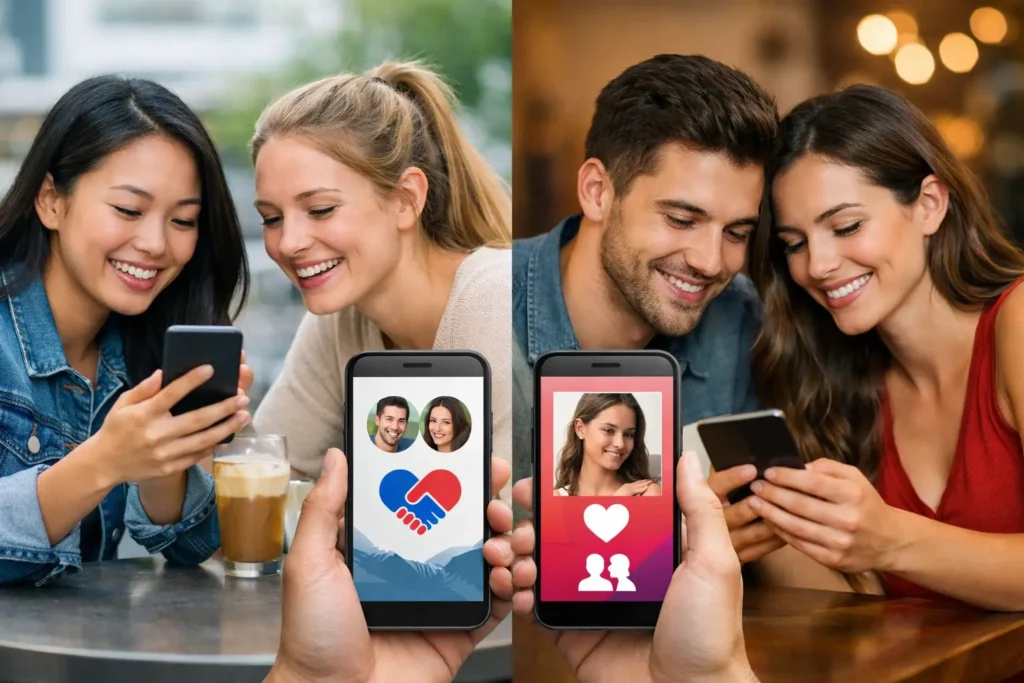
You download an app hoping to meet people in a new city, and within ten minutes you can usually tell what kind of experience it wants you to have. Is it asking who you want to build a life around, or just who you want to grab coffee with on Saturday? That is the real question behind friendship app vs dating app – and it matters more than most people expect.
For people who have relocated, started working remotely, gone through a breakup, or simply outgrown their old social circles, the difference is not minor. It shapes how you present yourself, how other people approach you, and whether the conversation actually turns into something real offline. If your goal is community, choosing the wrong app can leave you feeling more isolated, not less.
Friendship app vs dating app: the core difference
A dating app is built around romantic possibility. Even when the tone is casual, the structure usually assumes attraction first, then conversation, then some version of chemistry testing. Profiles tend to reward quick judgments. Photos carry more weight. Messaging often has an undercurrent of ambiguity because both people are trying to figure out interest, intention, and compatibility at the same time.
A friendship app starts from a different social contract. The goal is not romance. It is connection, shared interests, and real-life companionship. That changes the tone immediately. People are more likely to ask what neighborhood you live in, what classes you want to try, whether you like hiking, coworking, live music, or finding a trivia team. The pressure is lower, but the outcome can be deeper in a different way because the interaction is not trying to answer a romantic question right away.
That distinction can sound obvious, but in practice it changes everything. When the app is designed for friendship, users are not decoding mixed signals from the first message. They are looking for common ground.
Why the experience feels so different
The biggest difference between a friendship app vs dating app is not just intent. It is behavior.
On dating apps, people often make decisions fast. Attraction is part of the product, so the interface tends to encourage filtering, swiping, and ranking. That can work if you want a romantic connection and understand the trade-offs. It can feel efficient. It can also feel draining, especially if what you actually need is a sense of belonging.
On friendship-focused platforms, people usually interact with more context. Shared hobbies, routines, neighborhoods, and local plans matter more than a single clever opener. Instead of asking, “Would I date this person?” the question becomes, “Would I enjoy spending time with this person in real life?”
That is a healthier frame for many adults, especially those rebuilding a social life from scratch. Friendship tends to grow through repeated, low-pressure contact. You meet for a walk, a workout class, a language exchange, or a weekend event. Then you meet again. The relationship has room to develop naturally.
Dating apps can still lead to friendship, but that is not what they optimize for
People do make friends through dating apps. Sometimes a date does not turn romantic, and sometimes users say upfront that they are open to meeting platonically. But that is different from using a platform designed around friendship from the beginning.
When the product logic is romantic matching, friendship is often treated like a side effect. That creates friction. One person may be looking for connection after moving to town, while the other assumes flirtation. Even when everyone is kind, the mismatch can be tiring.
If you are already feeling socially off-balance, that ambiguity can make it harder to put yourself out there consistently.
Which one is better depends on what you need right now
This is where people often ask the wrong question. It is not really about which category is better. It is about which one matches your current season of life.
If you want romance, a dating app makes sense. That is what it is built to do. If you want a partner, there is no reason to avoid tools designed for romantic discovery.
But if you want local friends, a sense of routine, people to explore the city with, or a way to stop spending every weekend alone, a friendship app is usually the better fit. It reduces confusion and increases the odds of meeting people who are showing up for the same reason you are.
This is especially true for expats, remote workers, and newcomers. Many adults are not struggling to meet strangers. They are struggling to meet the right strangers in the right context. Friendship forms faster when there is a shared activity, some consistency, and clear expectations.
A friendship app is often better for building local life
If your real goal is to feel at home somewhere, dating alone will not solve that. A romantic connection can be meaningful, but it does not automatically give you a community. In fact, relying on dating apps as your main social outlet can make your world feel narrower.
Friendship platforms are better suited to helping you build a broader life. You are not just meeting one person. You are meeting people through interests, group activities, and repeated local experiences. That is how cities start to feel familiar. You recognize names, neighborhoods, favorite spots, and faces. Your social life becomes something you participate in, not something you wait for.
That is also why activity-based platforms often work so well. Doing something together removes some of the awkwardness of meeting from scratch. There is already a reason to hang out.
The emotional trade-offs most people do not talk about
Dating apps can be exciting, but they can also be emotionally noisy. Rejection feels sharper when attraction is front and center. Conversations can fade quickly. Intentions are not always clear. If you are in a vulnerable moment – after a move, after a breakup, after a big life change – that atmosphere can feel heavier than expected.
Friendship apps are not perfect either. Not every match becomes a close friend. Some chats still fizzle. Some meetups are just okay. Adult friendship takes effort, and no app can skip that part.
But the emotional tone is usually gentler. The stakes feel more human-sized. You are not trying to impress someone into wanting a future with you after three messages. You are just trying to meet people who fit your life and values.
For many users, that makes consistency easier. And consistency matters more than intensity when it comes to building real social ties.
How to choose between a friendship app vs dating app
A simple test helps. Ask yourself what you hope happens after the first good interaction.
If your answer is, “I want to see if there is romantic chemistry,” choose a dating app.
If your answer is, “I want someone to try that new cafe with, join a run club, explore the city, or become part of my weekly life,” choose a friendship app.
If the answer is both, you may use both – but do it intentionally. Use each app for what it is designed to do. That way you are not forcing a friendship need into a romantic product or expecting a friendship platform to solve your dating life.
Being honest about your goal saves time and protects your energy.
What to look for in a friendship app
Not every friendship app creates the same kind of experience. The strongest ones make it easy to move from online matching to offline interaction. Shared interests should be clear. Local discovery should be simple. Meeting up should feel normal, not like a huge social leap.
That is where platforms built around activities and community tend to stand out. If you can discover like-minded people, join events, and create plans of your own, the app becomes more than a chat tool. It becomes a bridge into real life. That is a big part of what makes Hyve feel useful for people starting over somewhere new. It is not just about finding people. It is about giving friendship somewhere to happen.
The better question is what kind of connection you want to build
When people compare friendship app vs dating app, they often focus on features. But the deeper difference is what kind of relationship each one helps grow.
Dating apps are built to test romantic potential. Friendship apps are built to support social belonging. One is about attraction and pair-bonding. The other is about community, rhythm, and shared life.
If you are trying to make a new city feel less anonymous, build a circle outside of work, or find people who genuinely fit your lifestyle, friendship is not the backup plan. It is the plan.
And once you start treating it that way, meeting people feels a lot less like performing and a lot more like coming home to your own life.