
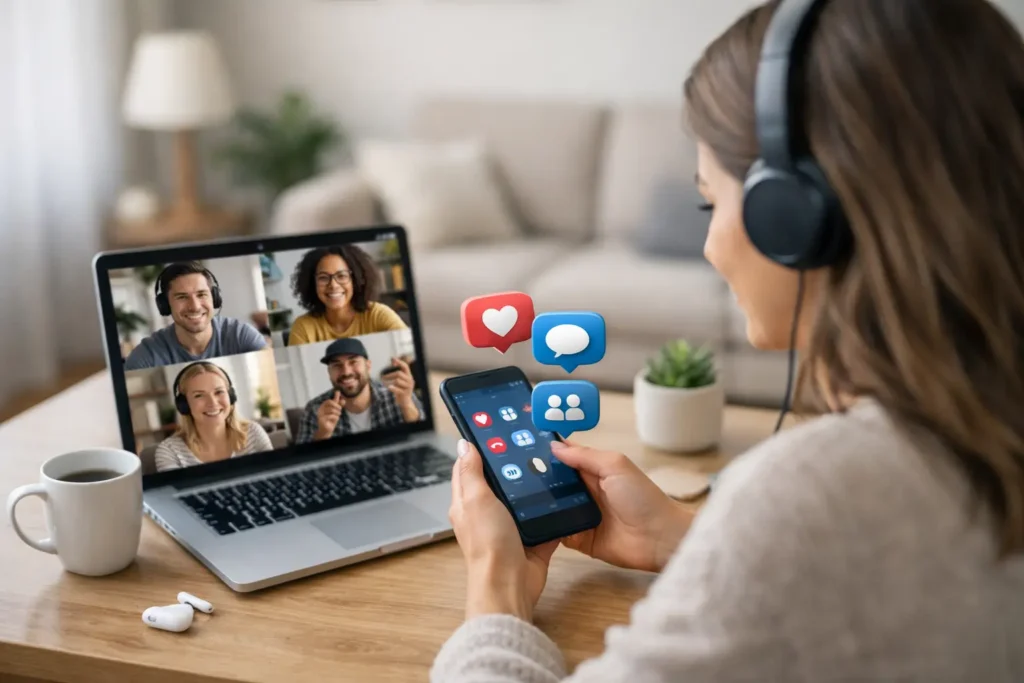
Your laptop can take you anywhere. Building a life there is the harder part. That’s why finding the right social app for remote workers matters so much – not as another screen to scroll, but as a way to meet actual people and feel more at home where you are.
Remote work gives you freedom, but it also removes a lot of the casual social structure most people used to rely on. There’s no hallway chat, no easy after-work drink, no familiar office rhythm that slowly turns coworkers into friends. If you’ve moved cities, started working from home, or landed in a new country with a strong Wi-Fi signal and no local circle, that gap gets very real very fast.
A lot of people try to solve that loneliness with the wrong tools. They join professional networking platforms when what they really want is companionship. They download dating apps when they’re not looking for romance. They sit in coffee shops hoping conversation will somehow happen on its own. Sometimes it does. Often, it doesn’t.
A good social app should make friendship feel easier, not more awkward. For remote workers, that usually means one thing: it needs to help turn online discovery into offline connection.
What a social app for remote workers should actually do
Not every app built around people is built around belonging. Some are great for messaging, some are useful for networking, and some are designed to keep you engaged without ever helping you leave the chat. If you work remotely, you probably don’t need more digital noise. You need a clearer path to meeting people you’d genuinely want to spend time with.
The best social app for remote workers usually gets a few things right.
First, it helps you meet people through shared interests, not just proximity. Living in the same neighborhood doesn’t automatically mean you’ll click. But if you both like weekend hikes, language exchanges, coworking sessions, or trying new food spots, there’s already something real to build on.
Second, it gives you a reason to meet that feels natural. This is where activity-based connection matters. It’s much easier to show up to a board game night, morning walk, or casual dinner than to start a blank chat and somehow turn it into friendship. Shared activities reduce pressure. They give conversation somewhere to go.
Third, it should feel clearly different from a dating app. A lot of adults want more friendship in their lives, but many platforms blur the line so much that every interaction feels loaded. For remote workers who are simply trying to create community, that gets tiring quickly.
Finally, a useful app should work for the life you actually have. Maybe your schedule changes every week. Maybe you travel often. Maybe you’re new in town and need something low-pressure because starting over already feels vulnerable enough. The right platform should support that reality instead of expecting you to perform confidence all the time.
Why remote workers need a different kind of social app
When people talk about remote work, they usually focus on flexibility, productivity, and work-life balance. Those matter, but social health is part of the picture too. Humans are not built to thrive on convenience alone.
Remote workers often live in a strange middle ground. You may be busy all day and still feel isolated. You may know people across time zones and barely know your own neighborhood. You may have chosen this lifestyle and still wish it came with a built-in community.
That tension is exactly why a social app for remote workers needs to be more intentional than a generic social platform.
Generic platforms assume your network already exists. They help you broadcast, comment, or stay loosely connected. But if you’ve just arrived in Austin, Miami, Lisbon, or Brooklyn and don’t know who to text on a Saturday afternoon, those platforms don’t solve the actual problem.
Remote workers also tend to need flexible, low-friction ways to connect. Traditional clubs or recurring events can be great, but not everyone can commit to the same schedule every week. Apps that make it easy to discover nearby people, join one-off activities, and connect around lifestyle fit are often more practical.
And then there’s the emotional side. Starting fresh can feel exciting one day and lonely the next. A good social product understands that people aren’t just trying to fill time. They’re trying to feel settled, seen, and part of something.
Signs an app will help you make real friends
A polished interface is nice. So are lots of users. But neither one guarantees meaningful connection.
What matters more is whether the app encourages real-world participation. If everything centers on profiles, swiping, and endless chat, it may keep you busy without helping you build anything. On the other hand, if the app nudges people toward creating plans, joining events, and meeting through common interests, it has a better shot at leading somewhere real.
Community density matters too, but in a practical way. An app doesn’t need millions of users everywhere. It needs enough of the right people in your area who are actually open to meeting. A smaller but more intentional community can be far more useful than a massive one filled with passive accounts.
It also helps when the culture of the app matches your goal. If the overall vibe feels transactional, flirt-heavy, or performative, friendship becomes harder. If the environment feels welcoming, activity-led, and clear about its purpose, people tend to show up more honestly.
This is one reason some remote workers are drawn to platforms like Hyve. The focus isn’t endless online interaction for its own sake. It’s meeting like-minded people, joining activities, and turning a new place into somewhere that feels familiar.
The trade-offs to think about
There isn’t one perfect app for everyone, because the kind of connection you want matters.
If you’re mostly looking for industry contacts, a professional networking platform may still be useful. If you want niche hobby groups, community forums can help. But if your bigger goal is friendship, those options often only get you halfway there.
Location also changes the experience. In larger cities, you may find plenty of events and new faces. In smaller towns, the pace may be slower, and you might need to be more proactive about creating your own activities instead of waiting for the perfect one to appear.
Your energy level matters too. Some people love large group events because they create easy momentum. Others find them draining and do better with smaller meetups built around one clear activity. A good app should support both, but it’s worth being honest with yourself about what kind of social setting helps you relax.
There’s also a timing factor. Friendship rarely happens instantly, even when the first meetup goes well. The app can open the door, but repetition builds trust. Sometimes the best result isn’t an instant best friend. It’s one familiar face, then another, then a growing sense that you belong here.
How to get more from a social app for remote workers
The app matters, but how you use it matters too.
If you’re new somewhere, start with activities you’d genuinely enjoy even if you only had one good conversation. That takes pressure off the outcome. It also increases the chance you’ll meet people who actually fit your lifestyle instead of just anyone available.
Try not to overthink your profile or your first message. Warm and clear beats clever every time. People are usually responding to the feeling of ease you create, not a perfect introduction.
It also helps to say yes a little more often than feels convenient at first. Not to everything, and not past your limits, but enough to give new connections a real chance. Community usually grows through small repeated moments, not one dramatic turning point.
And if you don’t click with the first event or person, that doesn’t mean the app failed or that friendship is harder for you than it is for everyone else. Chemistry is unpredictable. The goal is not to force instant closeness. It’s to create more opportunities for the right people to cross your path.
More than socializing, it’s building a life
For remote workers, friendship is often treated like a nice extra. Finish your tasks, manage your calendar, stay productive, then maybe think about meeting people. But that order misses something important. Feeling connected changes how a place feels. It affects your confidence, your routine, your mood, and whether your freedom actually feels good.
The right social app doesn’t just help you pass time after work. It helps you build a life around your work. That difference matters.
If you’re choosing a social app for remote workers, look for one that makes it easier to meet people in person, connect over shared interests, and take the awkwardness out of starting from scratch. A new city stops feeling so temporary when there’s someone to grab coffee with, join for a class, or text on a quiet Sunday. Sometimes that’s the real marker that you’ve settled in – not that you know the area, but that you know your people.
Pingback: How to Build Community in a New City - Hyve